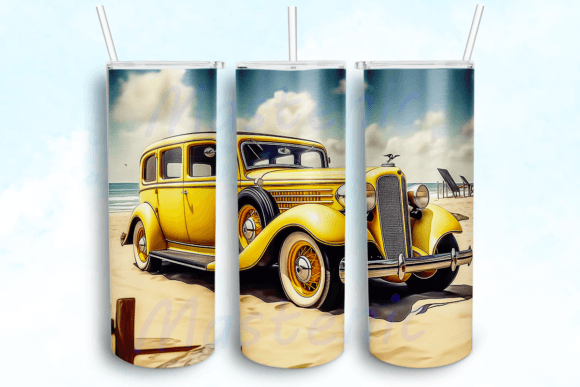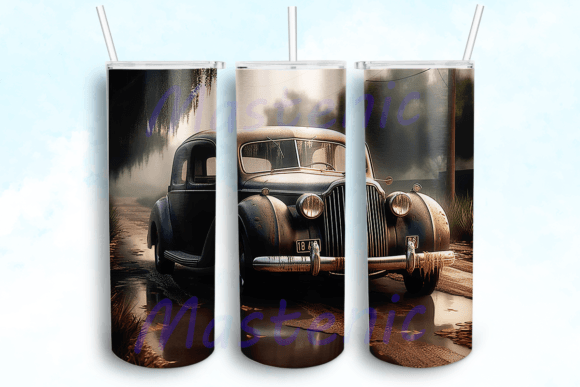
1930s Retro Car Tumbler Template
As a designer who’s stitched everything from nursery monograms to boutique apparel collections—and reviewed hundreds of digital embroidery files—I opened the 1930s Retro Car Tumbler Template with a quiet, practiced curiosity. Not excitement over novelty, but attention to intention: Does this design hold up under needle and thread? Will it translate cleanly on cotton twill, soft fleece, or textured linen? Most importantly—will the person holding the finished product feel that unmistakable spark of handmade charm?
I tested it first on a custom embroidered tote bag for a local vintage café’s holiday pop-up. The client wanted “joyful nostalgia”—not kitsch, not clutter. They’d seen the 1930s Retro Car Tumbler Template in my mockup library and asked if it could scale gracefully from tumbler to 12” x 14” canvas. That’s where real evaluation begins.
A Design That Breathes Like a Real Decade
The first thing that stands out is its rhythm—not just the sleek chrome grille or jaunty fender lines, but how the negative space wraps around the car’s silhouette. It’s not overly dense. There’s breathing room between wheels and body, which means fewer fill-stitch overlaps and cleaner satin-stitch edges when digitized properly. The tapered PNG file especially respects curvature—no distortion when wrapped around a mug or gently contoured pillow cover. That’s rare in retro automotive graphics, which often sacrifice proportion for flair.
This isn’t a racing stripe or a cartoon hot rod. It’s a gentle nod—elegant, slightly whimsical, unapologetically analog. That makes it ideal for projects where tone matters as much as technique: baby embroidery (think a cream gauze blanket), aprons for a retro diner pop-up, or even minimalist sweatshirt embroidery for a small shop selling mid-century home goods.
Where It Shines—and Where to Pause
The 1930s Retro Car Tumbler Template works beautifully on stable, medium-weight fabrics—cotton duck, brushed twill, linen-cotton blends. On a tea towel? Crisp and charming. On a structured cap front? Yes—if you use light tear-away stabilizer and keep stitch density moderate. I ran it at 75% density on a baseball cap and got clean wheel spokes without puckering.
But here’s the honest note: avoid it on highly stretchy knits (like lightweight jersey) without significant underlay and cutaway stabilizer. The curves demand stability. And while the design avoids tiny lettering or micro-details, those headlight accents *will* blur on thin fabric like voile or low-thread-count muslin—especially after washing. If you’re planning baby embroidery, test it on scrap pre-washed fabric first. Same goes for dark fabric: check contrast in both black-and-white and color mockups before committing thread.
It also doesn’t crowd the hoop. At 9.3 x 8.2 inches, it fits comfortably in a 5” x 7” hoop with breathing room—ideal for makers using standard home embroidery machines. No need to split or reposition unless you're scaling beyond its native proportions.
More Than Just a Graphic—It’s a Craft Business Asset
For Etsy sellers and craft business owners, the 1930s Retro Car Tumbler Template offers quiet versatility. It reads clearly in printable mockups—no pixelation, no watermark—which matters when you’re building listings for embroidered patches, personalized gifts, or small-batch merchandise. I used it in three distinct ways last month: as a center motif on a denim apron, as a border repeat on a kitchen towel set, and scaled down (with careful redigitizing) for an embroidered patch on a vintage-style cap.
Customers responded warmly—not just to the car itself, but to how *cohesive* the finished product felt. That’s because the design has inherent balance: horizontal emphasis, centered weight, and subtle symmetry. It doesn’t fight the garment; it settles into it. That builds trust. When someone buys a handmade product, they’re buying intention—and this template signals thoughtful curation, not clip-art convenience.
Practical Notes Every Embroidery Designer Should Keep Handy
- Always test on scrap fabric first—especially if pairing with textured or dark backgrounds.
- Review stitch density carefully. This design leans elegant, not heavy—over-stuffing fill areas dulls its retro lightness.
- Confirm hoop size compatibility. While the PNG fits standard hoops, verify your digitizing software handles the taper correctly before finalizing.
- Inspect small details in grayscale. Those headlights and grille lines must remain legible at reduced sizes—run a black-and-white preview before stitching.
- Use appropriate stabilizer. Light cutaway for knits, tear-away for stable wovens, and fusible + tear-away for layered garments like reversible tote bags.
- Check licensing terms before selling finished items or bundling as part of a digital embroidery file pack. This listing states it's for use on 20oz skinny tumblers—but commercial embroidery rights may vary.
Fitting the Mood, Not Just the Hoop
What makes the 1930s Retro Car Tumbler Template more than just another Crafts download is how easily it supports storytelling. It’s not shouting—it’s smiling. That makes it perfect for personalized gifts (a birthday sweatshirt for a classic car enthusiast), boutique branding (a small shop logo alternative), or holiday embroidery (imagine it stitched beside holly on a linen table runner). It doesn’t dominate; it invites.
I’ve seen too many embroidery files that look sharp on screen but collapse into muddy satin stitch on fabric. This one holds its shape. Its lines are confident but forgiving—ideal for makers still refining tension control or working across varied machine models. And because it avoids excessive detail, it translates well into applique design, too: cut the car shape from wool blend felt, then outline with running stitch for tactile warmth.
In short—the 1930s Retro Car Tumbler Template earns its place not as a trend-chaser, but as a quietly reliable design asset. It’s the kind of graphic that makes your finished product feel intentional, nostalgic, and unmistakably handmade. Whether you’re an Etsy seller building a cohesive line, a small shop owner curating seasonal merchandise, or a hobbyist stitching heartfelt gifts—it doesn’t just fill space. It carries mood, memory, and quiet craftsmanship forward.